

What Is Generative Engine Optimization (GEO)?
Generative Engine Optimization (GEO) is the practice of optimizing digital content to maximize its visibility in AI-driven search environments, especially when large language models (LLMs) synthesize and present answers directly to users. Unlike traditional SEO, which focuses on ranking in search engine result pages (SERPs), GEO aims to get your content referenced, summarized, and cited by generative AI tools.
In the AI search era:
-
Users increasingly ask conversational queries rather than short keywords.
-
AI systems synthesize multiple sources to generate responses rather than serving lists of links.
-
A brand’s visibility may depend on whether an AI model uses its content in answers, not just where it ranks in a traditional search.
In short, GEO helps ensure your content survives and thrives in AI-first discovery.
Why GEO Matters Now
The Search Paradigm Shift
Traditional SEO remains important, but users are increasingly turning to AI assistants for direct answers. Studies and industry analyses project that by 2026 and beyond, more than half of all search queries will be mediated by generative AI, fundamentally changing how people discover and interact with content.
AI search doesn’t just deliver links, it delivers answers. That means:
-
Users get information without clicking through to websites.
-
Intent becomes conversational and context-rich, not keyword-based.
-
Brands must compete not for positions, but for inclusion in AI narratives.
Implication for Brands
If your content is not optimized for AI comprehension, it risks being overlooked by the very platforms where users conduct their most important queries. Traditional SEO tactics like backlinks and keyword placement still matter but are no longer enough on their own. Generative Engine Optimization complements SEO by ensuring your content is structured and authoritative enough to be trusted and featured by AI.
Key Differences: Traditional SEO vs GEO
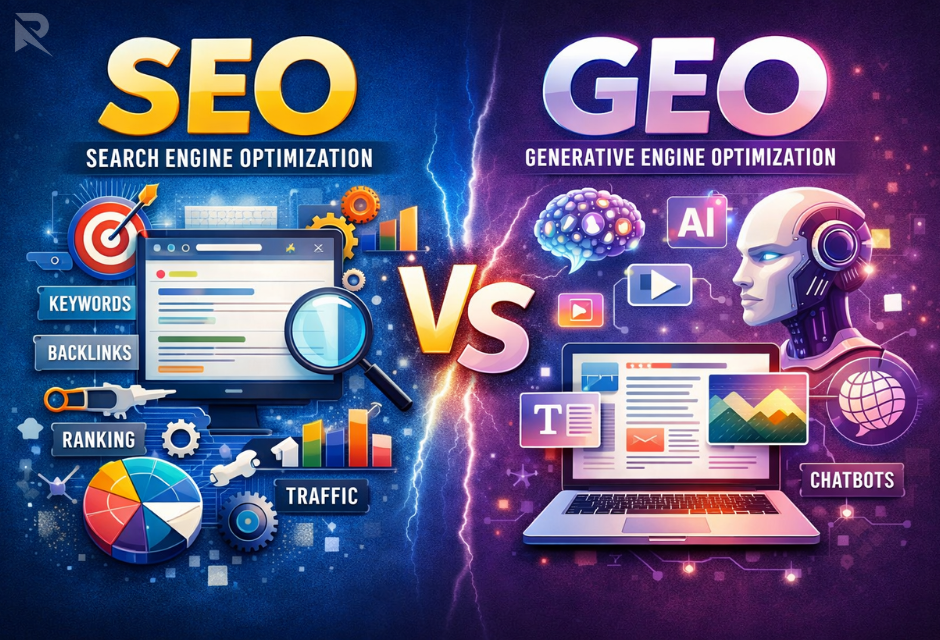
| Aspect | Traditional SEO | Generative Engine Optimization (GEO) |
|---|
| Objective | Rank on SERPs | Be referenced in AI responses |
| Focus | Keywords, backlinks, page rank | Semantic clarity, authority, structure |
| Metric | Clicks, impressions, rankings | AI citations, visibility in AI answers |
| Content Style | Short-form, keyword-rich | Comprehensive, conversational, well-sourced |
| Target | Search bots | AI language models and answer engines |
Core Principles of GEO for Brands
Semantic and Structured Content
AI systems understand meaning, not just individual keywords. Content should be:
-
Structured logically with clear headings, lists, and context
-
Semantic-rich (e.g., entity-based content that identifies key subjects)
-
Comprehensive and factual, helping AI synthesize accurate answers
This ensures generative models can interpret and extract your content effectively.
Conversational Query Targeting
Instead of optimizing for 1-3 word keywords, GEO encourages optimizing for natural language queries, the kinds of questions users ask in chat interfaces. For example:
“What are the latest digital marketing optimization strategies for AI search?”
This style mirrors how humans interact with AI, and how AI retrieves relevant content from trusted sources.
Authority and Trust Signals
AI search systems rely on credibility cues. That means content must:
-
Cite credible sources
-
Use statistics, case studies, and verifiable facts
-
Be updated regularly
Authoritative content is more likely to be included in AI answers.
Technical Accessibility for AI Crawlers
AI visibility depends on structural accessibility, similar to SEO, but with AI-specific considerations:
-
Clear HTML structure
-
Semantic markup (e.g., schema)
-
AI-friendly accessibility in indexing and knowledge layers
This helps AI models crawl, read, and incorporate your content efficiently.
How Brands Can Implement GEO, Step by Step
1. Audit Your Content for AI-Readability
Assess how clearly your pages answer potential user questions. Ensure your content:
-
Uses clear headings
-
Provides deep insights
-
Has FAQs and natural language responses
This boosts the likelihood of AI relevance and citation.
2. Optimize for Conversational Queries
Structure blog posts and landing pages around common questions your audience asks, ideally in conversational form.
Example:
Instead of:
“SEO services Delhi”
Use:
“How can small businesses in Delhi improve their online visibility in the AI search era?”
Conversational content better aligns with AI query patterns.
3. Build Credibility and Authority
Incorporate expert insights and data points in your content. Use internal and external references wisely, AI models pick up trusted materials more reliably.
4. Monitor AI Visibility
Traditional analytics won’t tell you everything about AI citations. Use tools that track when and how your content appears in generative AI answers, a new KPI for digital marketing.
Why This Matters for Rebtrox Clients
At Rebtrox, we understand that visibility isn’t just about ranking high on Google, it’s about being present where your customers are asking questions in real time. Whether through:
- SEO
- AI-optimized content strategy
- Structured content that aligns with GEO principles
- Digital marketing campaigns that anticipate AI search patterns
Rebtrox helps brands win visibility in both traditional and AI-driven search environments, ensuring your digital strategy remains future-proof.
Our expertise in advanced content strategy, semantic optimization, and integrated digital marketing positions your brand to thrive as AI adoption accelerates.
Learn more about our digital marketing services at Rebtrox.
Conclusion: The Future of Search Is Here
Generative Engine Optimization is not a fleeting buzzword, it’s the next evolution of search visibility. Brands that adapt now will get:
- Enhanced visibility in AI-powered search
- Higher credibility through AI citations
- Competitive advantage over brands relying solely on traditional SEO
- Greater discovery in conversational search landscapes
Traditional SEO will continue to matter, but GEO ensures your content is not just found, but used.
In the AI age, visibility means inclusion, and GEO is the strategy that makes inclusion possible.
Generative Engine Optimization (GEO): Frequently Asked Questions
What is Generative Engine Optimization (GEO)?
Generative Engine Optimization (GEO) is the process of optimizing digital content so it can be understood, selected, and referenced by AI-powered search engines like ChatGPT, Google AI Overviews, Gemini, Perplexity, and other large language models (LLMs).
Unlike traditional SEO, which focuses on ranking web pages on search engine result pages (SERPs), GEO focuses on making your content eligible to appear inside AI-generated answers. This includes optimizing for semantic clarity, structured data, topical authority, and conversational queries that AI systems rely on to generate accurate responses.
How is GEO different from traditional SEO?
Traditional SEO is designed to improve visibility in link-based search results, whereas GEO is built for answer-based AI search experiences.
Key differences include:
-
SEO targets rankings; GEO targets AI citations and inclusion
-
SEO focuses on keywords; GEO prioritizes entities, context, and meaning
-
SEO measures clicks; GEO measures brand mentions, authority, and visibility in AI outputs
At Rebtrox, GEO is treated as an extension of modern SEO, not a replacement, both strategies work together to maximize digital visibility.
Why is Generative Engine Optimization important for brands in 2026 and beyond?
AI search is rapidly changing how users discover information. Many users now get answers without clicking on websites, directly from AI tools. If your brand is not optimized for GEO, your content may never be surfaced, even if it ranks well on Google.
GEO helps brands:
-
Stay visible in zero-click AI answers
-
Build authority in emerging AI ecosystems
-
Future-proof digital marketing strategies
-
Reach users earlier in the decision-making process
Brands that adopt GEO early gain a significant competitive advantage.
How do AI search engines choose which content to reference?
AI search engines evaluate content based on multiple trust and relevance signals, including:
-
Depth and accuracy of information
-
Clear structure (headings, lists, FAQs)
-
Topical authority and consistency
-
E-E-A-T signals (Experience, Expertise, Authoritativeness, Trustworthiness)
-
Freshness and contextual relevance
This is why long-form, well-structured, expert-driven content performs far better in GEO than thin or keyword-stuffed pages.
What type of content performs best for Generative Engine Optimization?
The most effective GEO content includes:
-
In-depth educational blog posts
-
Long-form guides and explainers
-
FAQs with clear, direct answers
-
Thought-leadership articles
-
Industry insights backed by data and examples
Rebtrox focuses on value-first content strategies, ensuring every piece of content answers real user questions in a way AI systems can easily interpret and trust.
Does GEO replace SEO, or do brands need both?
GEO does not replace SEO, it enhances it. Traditional SEO ensures your content is crawlable, indexable, and discoverable, while GEO ensures it is usable by AI systems.
A successful digital strategy includes:
-
Technical SEO for performance and indexing
-
On-page SEO for keyword and intent optimization
-
GEO for AI visibility and answer inclusion
At Rebtrox, we integrate SEO + GEO + content strategy into one unified growth approach.
How can businesses start implementing GEO effectively?
Brands can start GEO implementation by:
-
Auditing existing content for depth, clarity, and structure
-
Updating pages to answer conversational, long-tail questions
-
Adding detailed FAQs and schema markup
-
Strengthening E-E-A-T signals with expert insights and data
-
Publishing authoritative content consistently
A professional GEO strategy ensures these steps are executed correctly and aligned with business goals.
Can Rebtrox help with Generative Engine Optimization strategies?
Yes. Rebtrox provides future-ready digital marketing solutions, including:
-
SEO + GEO-aligned content strategies
-
AI-optimized blog and landing page creation
-
Semantic and entity-based optimization
-
Technical SEO for AI accessibility
-
Performance tracking and optimization
Our approach ensures your brand remains visible, credible, and competitive in both traditional and AI-powered search ecosystems.
